
CANNABINOIDS · TERPENES · FULL-SPECTRUM HEMP
What Is the Entourage Effect?
The entourage effect is the idea that cannabinoids, terpenes, and other compounds in cannabis may influence one another when they are consumed together. The concept is widely discussed in cannabis marketing, but the science is more nuanced than the phrase often suggests.
QUICK ANSWER
Is the Entourage Effect Real?
The entourage effect is a scientific hypothesis describing potential interactions among cannabis compounds. Some cannabinoid combinations clearly can interact pharmacologically, but evidence that full-spectrum cannabis reliably produces superior effects because of broad cannabinoid-terpene synergy remains limited. [1] [2]
Where Did the Entourage Effect Idea Come From?
The term “entourage effect” originated in cannabinoid research in the late 1990s. The original work did not establish that every compound in cannabis makes THC or CBD work better. It described a specific biological observation in which related endogenous compounds appeared to modify the activity of an endocannabinoid. [3]
The term was later applied more broadly to cannabis and the idea that combinations of cannabinoids, terpenes, flavonoids, and other plant compounds may influence the overall pharmacological effect of an extract.
What Compounds Are Involved?
Cannabis sativa produces a chemically diverse mixture of plant compounds. The two groups most often discussed in relation to the entourage effect are cannabinoids and terpenes.
Do Cannabinoids Interact With Each Other?
They can.
The clearest reason to take the entourage concept seriously is that cannabinoid pharmacology is not necessarily limited to isolated compounds acting independently.
CBD and THC, for example, have different mechanisms of action and can influence the overall pharmacological profile of cannabinoid formulations. But that does not mean every cannabinoid combination creates a beneficial or predictable synergy.
IMPORTANT DISTINCTION
“Compounds can interact” and “full-spectrum products are always better” are not the same scientific claim.
What Role Do Terpenes Play?
Terpenes are responsible for much of the distinctive aroma associated with cannabis and many other plants.
They are also biologically active molecules, which makes it plausible that some terpenes could influence the overall effects of a cannabinoid preparation.
The difficult part is demonstrating meaningful cannabinoid-terpene synergy under real-world conditions.
A 2024 systematic review found exploratory evidence for individual biological effects of some terpenes but concluded that synergistic or additive enhancement of cannabinoid efficacy by terpenes remains unproven. [2]
Laboratory research has also failed to show that several commonly discussed cannabis terpenes directly modify THC or CBD activity at CB1 or CB2 cannabinoid receptors. [4]
WHAT THE EVIDENCE SUPPORTS
Plausible Does Not Mean Proven.
Cannabis contains many biologically active compounds, and interactions among them are scientifically plausible.
What has not been established is a universal rule that a complex full-spectrum extract will consistently outperform isolated cannabinoids because of a predictable “entourage effect.”
What Does Full-Spectrum Mean?
Full-spectrum is a formulation term, not proof of an entourage effect.
A full-spectrum hemp extract retains CBD together with additional compounds from the hemp plant and can contain other cannabinoids, terpenes, and trace amounts of THC.
Broad-spectrum products generally retain multiple hemp compounds while attempting to remove or substantially reduce THC. CBD isolate is a highly purified form of CBD intended to separate CBD from the broader plant extract.
Is Full-Spectrum CBD Better Than CBD Isolate?
Science does not support a universal answer.
A person may prefer a full-spectrum formulation because it retains a broader plant profile. Another person may prefer isolate because they want a simpler formulation or want to minimize exposure to THC.
Those are meaningful product differences. They should not be turned into unsupported claims that one format is inherently more effective for every consumer.
What Should Consumers Look For?
Why We Still Use Full-Spectrum Hemp Extract
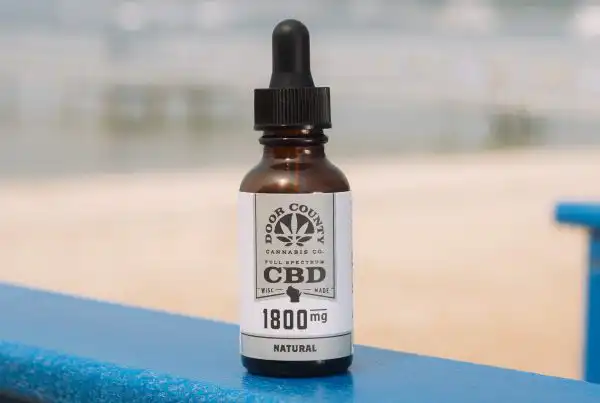
Door County Cannabis Co. has traditionally used full-spectrum hemp extract in several CBD products because we prefer to preserve a broader representation of the hemp plant rather than formulate every product with isolated CBD alone.
We do not present that choice as proof that an entourage effect will occur or that full-spectrum CBD is universally superior.
It is a formulation choice. The laboratory results and ingredient information should tell you what is actually in the product.
Frequently Asked Questions
Is the entourage effect scientifically proven?
Not as a universal or predictable phenomenon. Research supports the possibility of interactions among cannabis compounds, but recent reviews conclude that evidence remains insufficient to claim consistent beneficial synergy across full-spectrum products. [1] [2]
Do terpenes make THC or CBD stronger?
That has not been reliably established. Some terpenes have biological activity of their own, but current evidence does not establish predictable enhancement of cannabinoid effects from terpene combinations.
Is full-spectrum the same as the entourage effect?
No. Full-spectrum describes a product containing a broader range of hemp compounds. The entourage effect is a hypothesis about how compounds may interact.
Does full-spectrum CBD contain THC?
It can. Full-spectrum hemp extracts can contain naturally occurring trace THC. Check the current Certificate of Analysis for the actual cannabinoid profile.
FULL-SPECTRUM HEMP
Know the Product Beyond the Marketing Term.
Door County Cannabis Co. uses full-spectrum hemp extract in several of our CBD products. That means the formulation contains CBD alongside a broader range of naturally occurring hemp compounds.
We believe the better approach is transparency: identify the extract, make laboratory testing available, and let customers see what is actually in the product rather than promising a guaranteed “entourage effect.”
Sources & Further Reading
- Simei JLQ, Souza JDR, Lisboa JR, et al. Does the “Entourage Effect” in Cannabinoids Exist? A Narrative Scoping Review. Cannabis and Cannabinoid Research. 2024;9(5):1202–1216. View on PubMed .
- André R, et al. The Entourage Effect in Cannabis Medicinal Products: A Comprehensive Review. Pharmaceuticals. 2024;17(11):1543. View on PubMed .
- Ben-Shabat S, et al. An entourage effect: inactive endogenous fatty acid glycerol esters enhance 2-arachidonoyl-glycerol cannabinoid activity. European Journal of Pharmacology. 1998.
- Santiago M, Sachdev S, Arnold JC, McGregor IS, Connor M. Absence of Entourage: Terpenoids Commonly Found in Cannabis sativa Do Not Modulate the Functional Activity of Δ9-THC at Human CB1 and CB2 Receptors. View on PubMed .
This article is for general educational purposes. The entourage effect remains an active area of research. Evidence for interactions among cannabis compounds should not be interpreted as proof that any consumer hemp product treats, cures, prevents, or mitigates a disease or that full-spectrum products are universally more effective than isolated cannabinoids.